Structural Drying and Dehumidification in Beverly Hills, CA
The drying team sizes air movers and dehumidifiers to the class of loss, dries framing, subfloor, plaster, hardwood and concrete, and keeps the equipment running until readings match a dry reference.
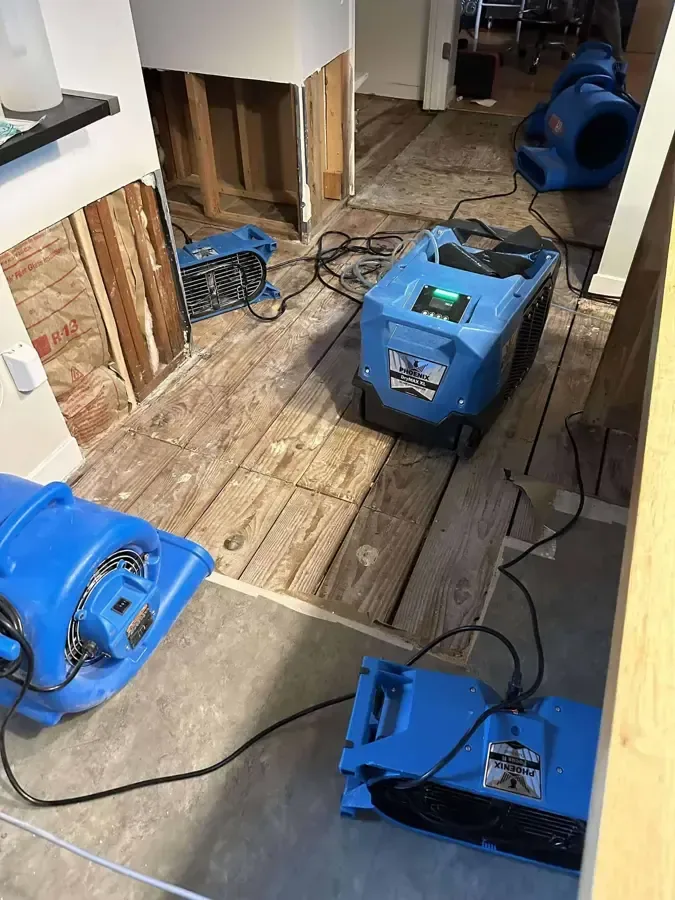
Water that soaks into framing, subfloor and plaster stays there long after the floor looks dry. Structural drying removes it on purpose: the drying team measures how wet each material is, sizes equipment to the room and checks progress every day. Older homes in Beverly Hills with plaster walls, hardwood and stone floors need slower, careful drying.
Class of loss sets the equipment
The IICRC S500 class describes how much water the materials took on:
- Class 1: a small area of low-porosity materials, few air movers needed
- Class 2: a whole room with carpet, pad and wall bottoms wet
- Class 3: water from above, with walls and ceilings soaked
- Class 4: dense materials such as hardwood, plaster, stone and concrete
Walls and floors still wet after a leak? The drying team sets up 24/7.
Get the drying plan builtLGR, desiccant and drying mats
LGR dehumidifiers pull water from the air even as it gets drier, which keeps evaporation going. Desiccant units handle cool spaces and dense materials like concrete and plaster. Drying mats draw water up through hardwood, and injection drying pushes dry air into wall cavities through small holes.
How dry is proven
Each day the drying team logs temperature, humidity and grains per pound inside the containment and outside it, and takes readings at marked points. Equipment comes out when wet materials read within 2 to 4 points of a dry reference material in the same building, and those logs go into the claim file.
What does structural drying and dehumidification cost in Beverly Hills, CA?
Structural drying typically runs $1,200 to $9,000 here, depending on the class of loss, the square footage, the water category, how much hardwood, plaster or concrete is wet and how fast drying started.
- Air movers
- LGR dehumidifier
- Daily logs
- Containment
- Wall cavity drying
- Ceiling drying
- Desiccant units
- Hardwood drying mats
- Injection drying
These are typical ranges, not a quote. Water category, square footage, material class and how fast drying started move the number most. The water damage cost calculator gives a closer planning range.
How dry is judged
Equipment comes out on readings, not on a calendar. Wet framing, subfloor and drywall have to read within 2 to 4 points of a dry reference material in the same building, and the daily logs go into the claim file.
Further reading: OSHA flood cleanup safety and EPA flood cleanup advice.
Structural drying and dehumidification across Beverly Hills and nearby communities
Dispatch runs day and night, weekends and holidays included, across every street listed here.
Dispatch reaches ZIP 90210, 90211 and 90212 plus the P.O. box ZIPs 90209 and 90213, from the hillside streets of Trousdale Estates down through the Flats, the Golden Triangle and South of Wilshire to the West Gateway and the blocks around La Cienega Park.
Nearby coverage reaches West Hollywood, Bel Air, Beverlywood, Carthay, Fairfax District, Los Angeles, Inglewood, El Segundo.
Structural Drying and Dehumidification: questions and answers
Why do drying fans have to run day and night?
Evaporation stops when the equipment stops, and wet materials can take moisture back from the air. Continuous drying keeps the job short and limits damage to finishes.
What does drying to a dry reference mean?
A dry reference is a reading from the same material in an unaffected part of the building. Wet materials are dried until they read within 2 to 4 points of it.
Can plaster walls be dried in place?
Usually, if they are structurally sound. Plaster dries slowly, so injection drying through small holes and desiccant or LGR dehumidifiers may run longer than for drywall.
How many air movers does a room need?
It depends on the class of loss and the room's wet area. IICRC S500 gives sizing guidance, and the drying team adjusts based on daily readings.
Why is the room so warm during drying?
Warm air holds more moisture and speeds evaporation. Dehumidifiers and air movers raise the temperature a little, which is normal and helps the structure dry faster.
Floor looks dry but readings say wet? Finish the drying.
Water left in framing and subfloor keeps damaging finishes long after the surface dries. The drying team runs equipment until the readings prove it is dry.
(888) 578-6508Book the structural drying setup