Structural Drying and Dehumidification in Manhattan Beach
Once the water is out, air movers and dehumidifiers dry the wet framing, subfloor and drywall. The same method serves homes and the office buildings along the Rosecrans corridor.
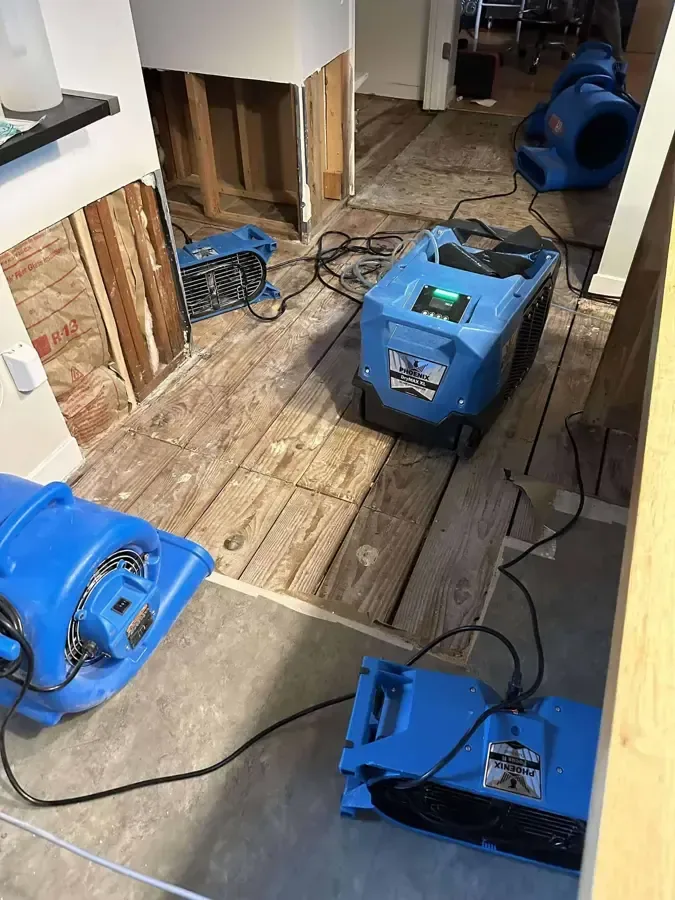
Drying is a measured process, not a matter of running fans. After the water has been extracted, wet framing, subfloor and drywall still hold moisture that can warp wood, loosen finishes and linger inside wall cavities. Structural drying places equipment where readings call for it, then moves or removes it as the numbers fall.
Equipment and what it does
Each piece has its own job:
- Air movers push dry air across wet floors and walls
- Dehumidifiers pull moisture out of the air so it can absorb more
- Drying mats and wall panels draw water from hardwood and drywall bottoms
- Meters and thermal cameras show where moisture is hiding
Water gone but walls still damp? Describe the rooms and the drying layout follows.
Ask about moistureHomes and larger buildings
A single room in a house needs a handful of units, while a large office floor needs a layout, a power plan and a schedule. The Rosecrans corridor has office buildings, shopping centers and restaurants, so equipment counts rise with the floor area.
Business losses are described separately under commercial water damage.
When drying is done
Readings are logged at each visit, and the equipment stays until walls, floors and framing match the dry reference in unaffected areas. Photos and logs then go to the owner, landlord or adjuster. The first step in every job, extraction, is covered under water extraction.
What does structural drying and dehumidification cost in Manhattan Beach, CA?
One room with class 1 or 2 materials usually costs $1,200 to $3,000. Class 3 drying across several rooms moves to $3,000 to $6,000, and dense class 4 materials reach $6,000 to $9,000+.
- Equipment placed
- Daily readings
- Short drying run
- Walls and ceilings dried
- More equipment
- Longer schedule
- Hardwood or concrete dried
- Specialty drying mats
- Extended monitoring
Treat these as planning ranges, not a quote: the category of water, how many square feet got wet, the material class and how soon drying began set the final figure. The water damage cost calculator narrows the range for one loss.
When the equipment leaves
Air movers and dehumidifiers stay until wet materials match a reading from dry material elsewhere in the same building, usually within 2 to 4 points, and every daily reading is kept for the adjuster.
Further reading: OSHA flood cleanup safety and EPA flood cleanup advice.
Structural drying and dehumidification across Manhattan Beach and nearby communities
Crews cover these neighborhoods at any hour, including nights, weekends and holidays.
Structural drying equipment is placed in homes across the Hill Section, the Tree Section, Manhattan Heights and the Sand Section, and in the office buildings, shopping centers and restaurants along the Rosecrans corridor, from Sepulveda Boulevard toward Aviation Boulevard.
The same service nearby: structural drying and dehumidification in Beverly Hills, El Segundo, Hawthorne.
Water damage restoration in Manhattan Beach › Every town covered ›
Structural Drying and Dehumidification: questions and answers
How long does structural drying take?
Several days is common, but it depends on the materials and the amount of water. Dense materials such as hardwood and concrete take longer, and readings decide when equipment is removed.
Why are dehumidifiers needed as well as fans?
Fans move moisture off surfaces into the air, and without a dehumidifier that humid air would just resettle on walls. Together they carry the water out of the room.
What do the drying classes mean?
Class 1 and 2 involve less water or materials that release it quickly, class 3 covers heavy water soaking walls and ceilings, and class 4 covers dense materials that hold moisture deep inside.
Can wet drywall be dried in place?
Often, when the water was clean and the drying starts early. Drywall that has swollen, crumbled or stayed wet for days is more likely to be cut out.
Why does the equipment run all day?
Moisture leaves materials slowly, and stopping lets humidity rebuild. Constant circulation and dehumidification keep the gradient moving until the readings match the dry reference.
Dry to the readings, not to the eye
Tell the crew what was wet, what the floors and walls are made of and when the water was removed, and the equipment layout and schedule are set from that.
(888) 578-6508Call about dehumidifiers